
Every Wyoming business owner has been there. The internet goes down on a Tuesday morning. The server stops responding. An employee gets locked out of a critical account right before a deadline. You call someone, they fix it, you pay the bill, and life moves on.
That model — call someone when something breaks, pay for the fix, repeat — is what the IT industry calls break-fix support. For decades, it was the standard. For many Wyoming businesses, it still is.
But the landscape has changed significantly. Technology now runs deeper into daily operations than it ever has. Cyber threats are more sophisticated, more frequent, and more expensive to recover from. And the cost of even a few hours of downtime has climbed to levels that would have seemed extreme just five years ago.
This guide gives Wyoming business owners a clear, honest comparison between managed IT services and break-fix support — what each model actually delivers, what each one costs in practice, and how to decide which approach fits your business in 2026.
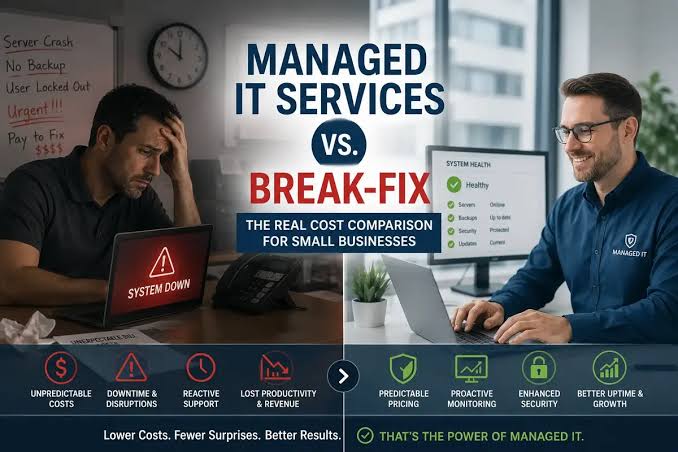
First, Let’s Define the Two Models Clearly
Before comparing them, it is worth being precise about what each model actually means — because these terms get used loosely.
What Is Break-Fix IT Support?
Break-fix is exactly what it sounds like. Something in your technology environment stops working. You contact an IT technician or company. They diagnose and fix the problem. You pay for the labor and any parts. The engagement ends there until the next problem occurs.
There is no ongoing relationship between service calls. No one is monitoring your systems in between. No one is running updates, checking backups, or watching for security threats. The IT provider is paid to react — and only when called.
Break-fix was the dominant IT support model for small businesses through much of the 2000s and 2010s. It is still widely used today, particularly for very small operations, home offices, and businesses with minimal technology footprints.
What Are Managed IT Services?
Managed IT services flip the model entirely. Instead of paying per incident, you pay a flat monthly fee to a Managed Service Provider (MSP) who takes ongoing responsibility for your technology environment.
What that responsibility looks like in practice: your systems are monitored around the clock, software patches and updates are applied proactively, security tools are deployed and maintained, backups are verified regularly, and your team has access to help desk support when they need it — all included in that flat monthly fee.
The core philosophy is prevention rather than reaction. The MSP’s job is to catch problems before they become outages, to block threats before they become breaches, and to keep your systems running so that you never have to make that emergency call in the first place.
The Real Cost of Break-Fix IT for Wyoming Businesses
Break-fix looks cheaper on paper. There is no monthly fee. You only pay when something actually goes wrong. For a business that rarely has IT issues, that sounds like the efficient choice.
The problem is that break-fix’s apparent cost advantage disappears the moment you account for what it actually costs when things go wrong — and in 2026, the cost of IT failures has reached levels that most small business owners have not fully calculated.
The Cost of Downtime Is Higher Than You Think
Research from 2026 puts the average IT downtime cost for small and mid-sized businesses at between $8,000 and $25,000 per hour depending on company size, industry, and technology dependence. A 15-person business losing access to cloud systems for two hours is looking at over 30 paid hours of idle staff time — before accounting for lost revenue, customer impact, or emergency repair fees.
The average small business experiences roughly two to three significant IT outages per year. Multiply a conservative estimate of $8,000 per hour by even two hours of downtime per outage across three incidents, and you are looking at $48,000 in downtime costs annually — not counting the IT bill to fix the problems.
For Wyoming businesses specifically, this math gets worse during peak operating periods. A tourism operator in Sheridan or a construction company coordinating jobsite work cannot absorb downtime the same way a business in a major metro can. When your booking system goes offline during summer tourist season, you are not just inconvenienced — you are losing customers who will not wait and will not come back.
Break-Fix Creates Perverse Incentives
There is an uncomfortable structural reality to the break-fix model that rarely gets discussed openly: the IT provider only earns money when things break. There is no financial incentive to prevent problems. There is no proactive monitoring, no patching schedule, no one verifying that your backups actually work. Those things cost time and are not billable under a break-fix arrangement.
This does not mean break-fix technicians are dishonest. It means the model itself is not designed for prevention. You are paying for firefighting, and no one is doing fire prevention.
Emergency Rates and Availability
When something critical breaks — a server failure on a Monday morning, a ransomware attack on a Friday afternoon — you are at the mercy of a provider’s availability and their emergency rates. Break-fix providers typically charge premium rates for urgent, after-hours, or weekend service calls. The same repair that costs $150 per hour during business hours may cost $250 or more when it happens outside them.
More importantly: under break-fix, there is no Service Level Agreement committing the provider to respond within any specific timeframe. You call, you wait, and the business sits idle.
The Hidden Cost of Unmanaged Security
Break-fix leaves your cybersecurity entirely unmanaged between service calls. No one is monitoring your network for intrusions. No one is checking whether your firewall rules are current. No one is verifying that your endpoint protection is actually running and updated. No one is applying the critical security patches that get released every month for operating systems, browsers, and business software.
In 2026, that gap is not a minor oversight. It is a significant vulnerability. Research shows that 80% of ransomware attacks target businesses with fewer than 1,000 employees — and the average ransomware recovery cost for a small business now exceeds $638,000, excluding any ransom payment. A break-fix model means no one is watching for these threats between the calls you make.
What Managed IT Services Actually Delivers
Managed IT is not just a different billing model. It is a fundamentally different relationship between your business and your technology infrastructure.
24/7 Proactive Monitoring
Your systems are watched continuously. If a server is running hot, if a hard drive is showing signs of failure, if someone is attempting to brute-force their way into your email accounts at 2 a.m. — the MSP knows about it and responds before it becomes your problem. Most issues that would become outages under a break-fix model are caught and resolved before they ever affect your operations.
Patch Management and System Updates
Unpatched software is one of the leading causes of successful cyberattacks against small businesses. Under managed IT, patches and updates for your operating systems, business applications, and security tools are applied on a regular, documented schedule. You do not have to think about it. The systems stay current automatically.
Verified Backup and Disaster Recovery
This is one of the most underappreciated differences between the two models. Many small businesses have some form of backup running — but have never verified that a restore actually works. Backups that fail silently are discovered only when you desperately need them after a disaster.
Managed IT includes regular backup verification as a standard part of the service. Your data is backed up, the restores are tested, and you have a documented disaster recovery plan. When something goes wrong — hardware failure, ransomware, accidental deletion — recovery is measured in hours, not days.
Predictable Monthly Costs
One of the most practical advantages of managed IT for small business budgeting is predictability. You know exactly what IT will cost every month. There are no surprise repair bills, no emergency call premiums, no “we found three other things wrong while we were fixing this” conversations. A flat monthly fee covers it all.
Research shows that 46% of small and mid-sized businesses reduced their annual IT costs by switching from break-fix to managed services. The savings come from fewer outages, fewer emergency repairs, and the elimination of the compounding costs that come with reactive IT management.
Strategic IT Planning
A good MSP is not just a help desk. They serve as your technology advisor — helping you plan hardware refreshes before equipment fails, recommending software that improves team productivity, identifying when your infrastructure needs to scale with your business, and ensuring your technology supports your business goals rather than constraining them.
Under break-fix, the technician fixes what is in front of them and leaves. Under managed IT, the provider has a stake in your long-term technology health.
Help Desk Access for Your Team
Your staff have IT questions and issues every day — software that will not cooperate, accounts that need setup, devices that need configuration. Under managed IT, they have direct access to a help desk staffed by technicians who know your environment. Issues get resolved fast, productivity stays up, and your team is not waiting days for a callback.
A Side-by-Side Comparison for Wyoming Business Owners
| Factor | Break-Fix IT | Managed IT Services |
|---|---|---|
| Cost structure | Per incident (unpredictable) | Flat monthly fee (predictable) |
| Typical cost | $75–$150/hr + emergency premiums | $100–$200/user/month |
| System monitoring | None between calls | 24/7 continuous |
| Patch management | Only when requested | Automated, ongoing |
| Cybersecurity | Unmanaged between calls | Built-in, proactive |
| Backup verification | Not included | Regular, documented |
| Response time | No guarantee | Committed SLA |
| After-hours support | Premium rates, if available | Included at flat rate |
| IT strategy & planning | None | Ongoing partnership |
| Best for | 1–3 users, minimal tech needs | 5+ users, operational dependence on tech |
The Wyoming Factor: Why This Decision Matters More Here
The managed IT vs. break-fix decision is important for any business. But there are specific characteristics of doing business in Wyoming that make it especially consequential.
Seasonal Revenue Windows Are Unforgiving
Wyoming’s economy is shaped by seasonal patterns that do not exist in the same way in major cities. Tourism season, construction season, hunting season, agriculture cycles — many businesses generate a disproportionate share of their annual revenue during specific windows. An IT outage during those windows is not just an inconvenience. It can define the financial outcome of the entire year.
A hotel in Sheridan losing its reservation system during the Fourth of July weekend does not recover those bookings after the fact. A construction company losing access to project files during a critical build phase faces direct schedule and cost consequences. The seasonal nature of Wyoming’s economy raises the cost of downtime well above national averages for comparable businesses in other markets.
Local IT Talent Is Limited
Finding and retaining qualified in-house IT staff is difficult in most markets. In Wyoming’s smaller communities, it is considerably harder. The pool of qualified IT professionals is smaller, salaries for in-house IT are significant for a small business, and a single internal IT person represents a single point of failure.
Managed IT gives Wyoming small businesses access to a team of technicians — L1, L2, and specialist-level — for a fraction of what a single in-house hire would cost. When one person is out sick, there is no gap in coverage. The team keeps running.
Cyber Insurance Is Getting Stricter
This is a development that has caught many Wyoming business owners off guard. Cyber insurance carriers are now requiring businesses to meet minimum security standards before approving or renewing coverage. Multi-factor authentication, documented backup procedures, endpoint protection, and employee security training are increasingly listed as prerequisites — not recommendations.
A business operating under pure break-fix with no managed security controls may find their cyber insurance claim denied after a breach, or their renewal rejected entirely until they can demonstrate baseline security measures. Managed IT builds those controls into your environment as part of the service.
Remote Location Means Recovery Takes Longer
In a major city, emergency IT help can often arrive within hours. In Sheridan, Cody, Gillette, or other Wyoming communities, getting a specialized technician on-site from out of state can take days. That reality makes prevention even more valuable than it is in urban markets. The further you are from a deep bench of on-demand IT resources, the more important it is to not need emergency intervention in the first place.
When Break-Fix Still Makes Sense
Managed IT is not the right answer for every Wyoming business. There are situations where break-fix remains the appropriate model.
Break-fix is probably sufficient if your business has fewer than three employees and your technology use is genuinely minimal — basic email, simple accounting software, no customer data storage. If IT issues are rare, if your operations can tolerate a half-day of downtime without significant financial impact, and if you have no compliance obligations around data security, break-fix may be an adequate and cost-effective approach.
A one-person consulting practice that works primarily from a laptop and stores files in the cloud may never need managed IT services. Their technology exposure is low, and their ability to work around issues while waiting for repair is relatively high.
The honest test is this: if your business went offline for a full business day tomorrow — no email, no network access, no software — what would that cost you? If the answer is “not much,” break-fix may work. If the answer involves lost revenue, missed appointments, frustrated customers, or operational chaos, managed IT is the appropriate model.
How to Make the Switch from Break-Fix to Managed IT
If you have been operating on break-fix and are considering making the transition, here is what a responsible onboarding process looks like with a reputable MSP.
The first step is a technology audit. A good provider will assess your existing systems before taking over management — documenting what you have, identifying immediate security gaps, inventorying your software and hardware, and understanding your backup situation. This is where most businesses discover things they did not know: backups that have not been running correctly, software that has not been updated in months, user accounts that belong to employees who left two years ago.
From there, the provider builds a baseline. Security gaps get addressed. Monitoring gets deployed. Backup procedures get documented and tested. This typically takes two to four weeks for a small business and may involve some upfront work to get your environment into a manageable state.
After that, the ongoing managed service model takes over: continuous monitoring, regular patching, verified backups, available help desk, and quarterly or annual business reviews to ensure your technology is aligned with where your business is heading.
What Managed IT Costs vs. What It Saves: The Wyoming Math
Let us run through a realistic scenario for a ten-person Wyoming business currently operating on break-fix.
Current break-fix situation:
- Average two IT incidents per year requiring professional support: 4 hours each at $125/hr = $1,000
- One significant outage per year: 6 hours of downtime at $5,000/hour estimated impact = $30,000
- One security incident every three years (amortized): $254,000 average breach cost / 3 = $84,667 per year
- Total estimated annual IT risk exposure: $115,667
Managed IT services:
- 10 users at $150/user/month = $1,500/month = $18,000 per year
- Estimated downtime reduction: 80–90% fewer significant incidents
- Security coverage included in the fee
The math does not require complex analysis. Even setting aside the breach risk entirely, the downtime reduction alone justifies the managed IT cost for most businesses with any meaningful technology dependence.
The Wired Wizards: Managed IT for Wyoming Businesses
The Wired Wizards is headquartered in Sheridan, Wyoming, and serves small and mid-sized businesses across northern Wyoming and beyond. With over 15 years of experience and a tiered team of L0, L1, and L2 technicians, they deliver managed IT services built for the reality of running a business in Wyoming — not generic support packaged for a corporate client in a major city.
Services include 24/7 remote monitoring and help desk access, on-site dispatch throughout the Sheridan region, server administration and network security, Microsoft 365 management, cybersecurity tools and endpoint protection, cloud setup and data migration, and break-fix response for hardware failures. The flat monthly model means Wyoming businesses get full coverage without unpredictable bills.
For businesses still operating on break-fix who are ready to evaluate the transition, The Wired Wizards offers an initial technology assessment to understand your current environment and what a managed services arrangement would look like for your specific situation.
Call +1-855-534-4116 or email support@thewiredwizards.com to get started.
It depends on how dependent your operations are on technology. A business with three or fewer employees and minimal tech needs may not need managed IT. But if your team relies on email, cloud software, network connectivity, or point-of-sale systems to operate — and especially if a day of downtime would cost you significant revenue — managed IT is almost certainly worth the predictable monthly investment.
Break-fix typically runs $75–$150 per hour plus emergency premiums. Managed IT is generally priced at $100–$200 per user per month for a comprehensive package. For a five-person business, that is $500–$1,000 per month. The key difference is that managed IT is predictable and includes prevention, security, monitoring, and help desk access — none of which break-fix provide.
